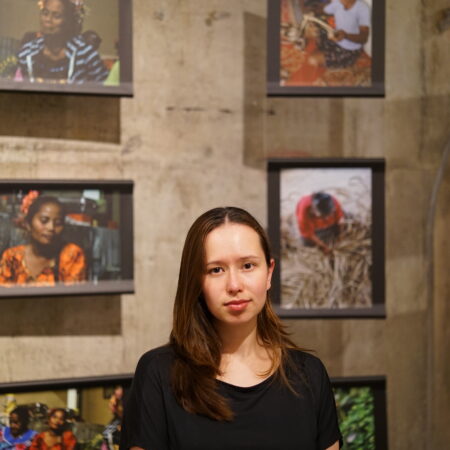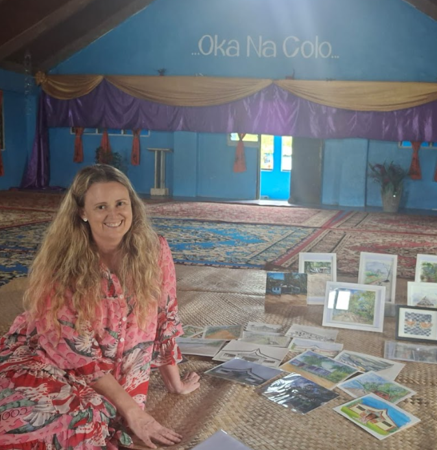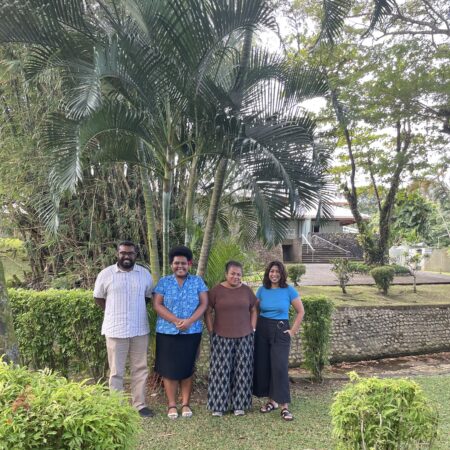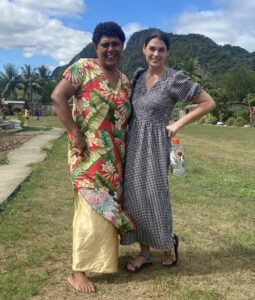
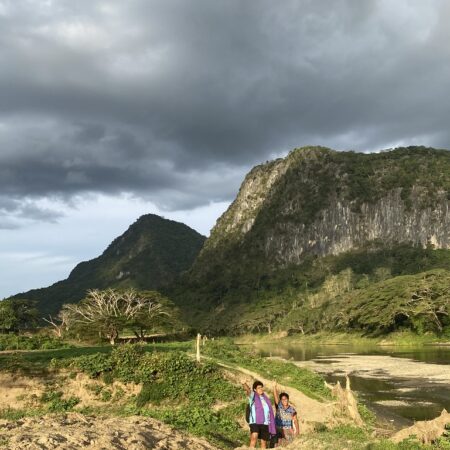
Women from the village showing Melanie a walk they typically take volunteers and tourists to showcases the history and tales of colonisation in the area
Melanie’s research topic: Cross-cultural Power, Connection and Impact of Volunteer Tourism in Fiji: Insights from Local iTaukei Perspectives
International development volunteering, including ‘voluntourism ‘, is a thriving form of humanitarian travel. Typically, travellers pay to join organised service projects hosted by countries in the ‘Global South’. However, some consider voluntourism morally controversial due to the risks of unskilled labour and its potential as a form of neocolonialism, given the inherent power dynamics. This ignited my deep interest in studying the phenomena through the lens of moral psychology. By conducting fieldwork in a rural village in Fiji, I was presented with an incredible opportunity to centre the voices and perspectives of those who host volunteers.
As a White American Woman, my identities parallel those of many volunteers. This offered a first-hand view of how volunteers are received in the village, but it was impossible to share participants’ perspectives. In fact, a large part of successfully completing this research involved navigating my positionality. I engaged in active reflexivity, humility, and learning, along with collaborating with local expertise and employing culturally relevant methods.
By engaging in talanoa, a traditional form of open dialogue grounded in empathy, I spent many hours sitting on mats in various homes, listening to the stories, sharing philosophies of life, and drinking tea with participants. This study quickly spanned beyond psychology and greatly stretched my expertise. Yet, in each talanoa, it was clear that there is a place for cross-cultural exchange that voluntourism currently offers. However, improved communication and cooperation must be equitable to intercept avoidable harm to hosting villages. The findings align with the message from decolonial research that voluntourism organisations and groups must redistribute power over Indigenous Vanua (land) back to whom it belongs. This does not mean there is no place for kaivalagi (outsiders) in Fiji; rather, it calls attention to the importance of community-led development.
MELANIE ALTEMUS | PHD OF PSYCHOLOGY | TE HERENGA WAKA | VICTORIA UNIVERSITY OF WELLINGTON